

For many, Shinshu is synonymous with soba, a local specialty that has flourished in Chino City, where the high elevation, pure mountain waters of the Yatsugatake range and Mount Tateshina, and cool climate create ideal conditions for growing buckwheat.
Today, Chino City is home to numerous soba restaurants, particularly along the Venus Line road leading to the Tateshina Highlands, a stretch also known as the “Soba Road” for its rich concentration of local soba spots.
Discover soba restaurants in Chino City and around the hotel here.
For those wishing to discover Shinshu’s celebrated soba culture firsthand, our Concierge Desk can recommend local workshops where guests can make soba noodles by hand.
This article explores the art of traditional soba-making through our hotel staff’s visit, from preparing the dough to shaping the noodles.
For this activity, our staff visited Yuurakuan, a traditional Shinshu hand-made soba workshop located approximately 10 minutes by car from the hotel and beloved by the local community.
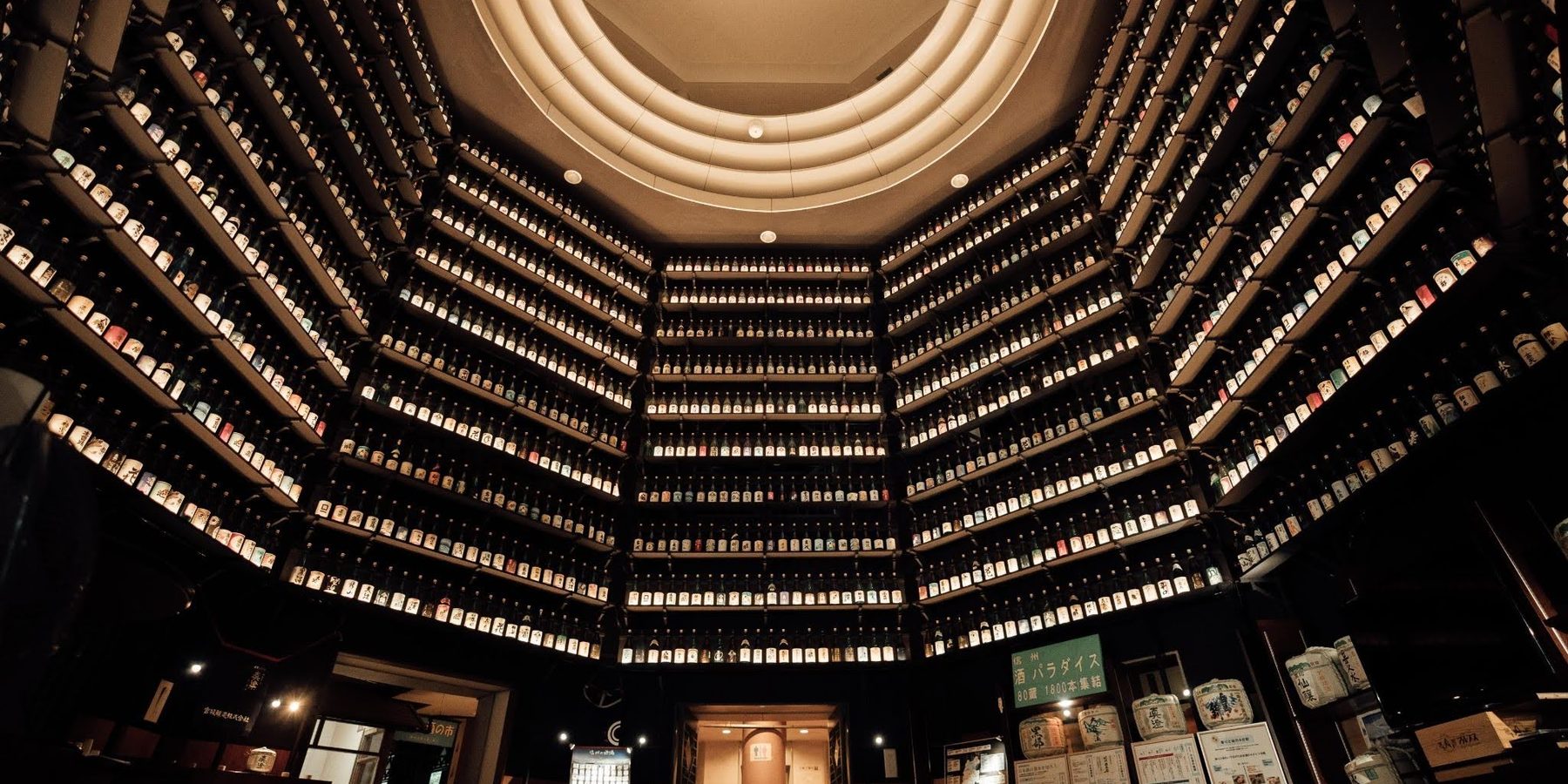
Upon entering, visitors are greeted by an impressive display of sake bottles lining an entire wall. At Yuurakuan, guests can enjoy a hands-on soba-making experience, savor freshly prepared soba at the adjoining restaurant, or explore the on-site Sake Museum, which offers a selection of Shinshu-produced beverages for purchase.
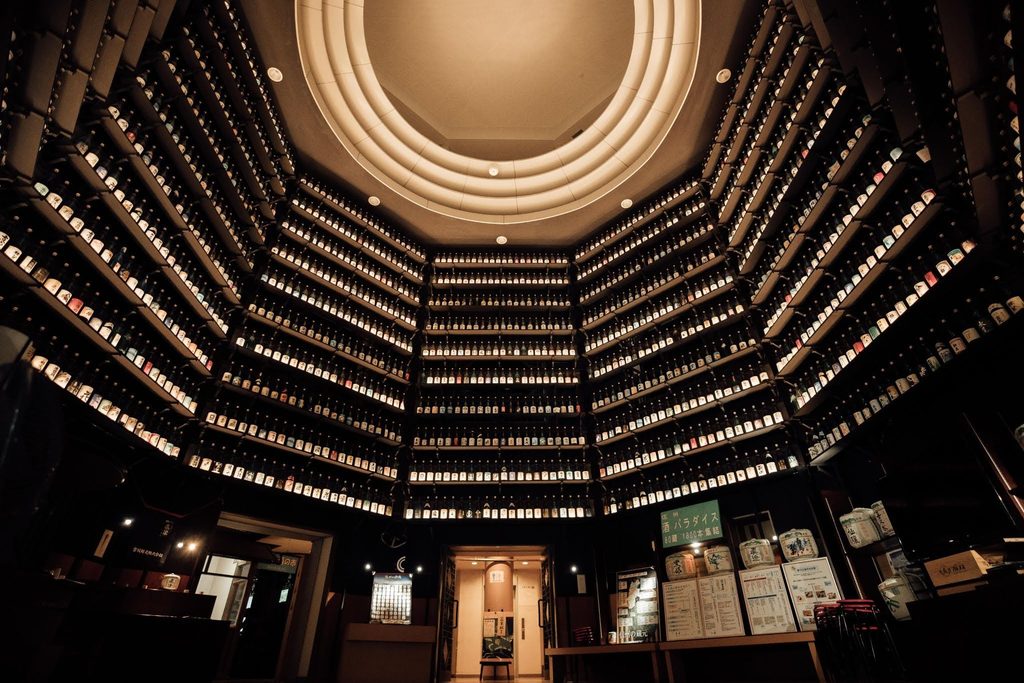
After taking in the impressive display, the journey continues upstairs to the second floor, where the soba-making experience takes place. Following a warm welcome and an introduction from the staff, participants begin by thoroughly washing their hands and putting on the provided aprons.
With preparations complete, the staff introduces the different stages of the soba-making process.
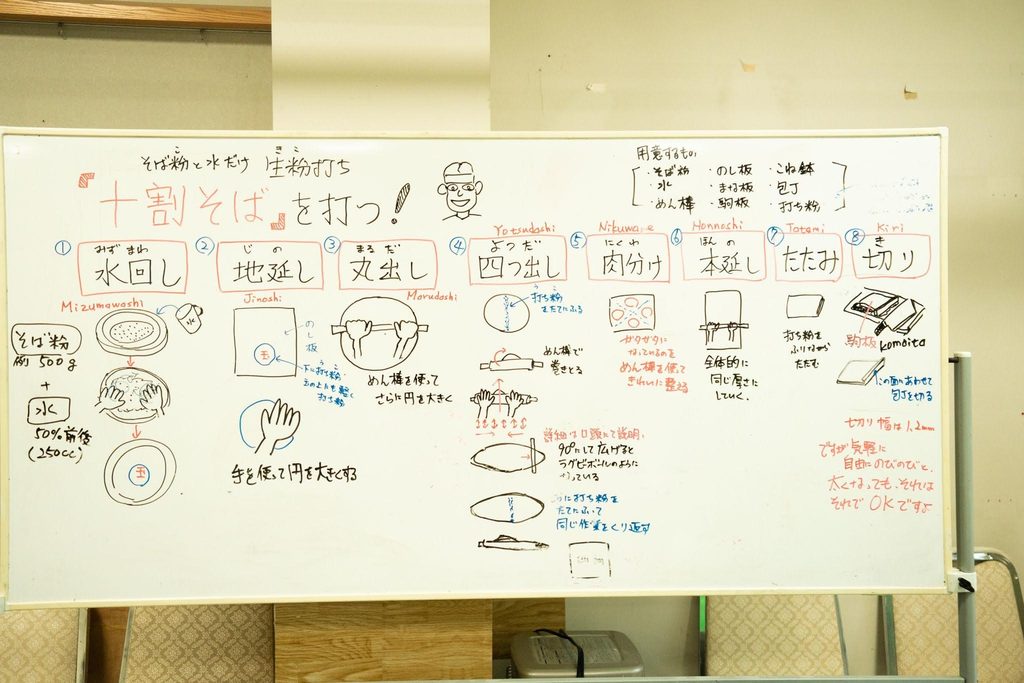
We participated in the Juwari Soba program, in which the noodles are made entirely from buckwheat flour, without any wheat flour or other binding agents.
This traditional style is prized for its distinctive aroma and rich, authentic flavor. Because the absence of a binding agent makes the dough more challenging to work with, preparing it requires a certain level of skill. However, the result is well worth the effort, offering a taste that is best enjoyed in freshly made noodles.
Step 1: Mizu-mawashi (Mixing the Water into the Buckwheat Flour)
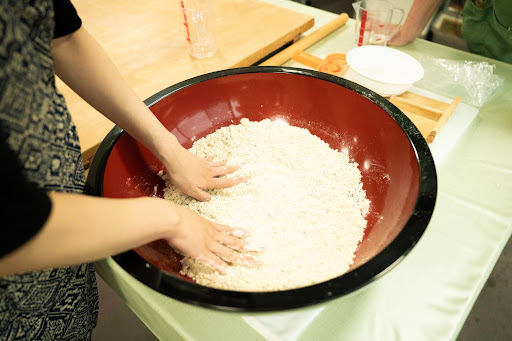
The first step is to gradually add water to the buckwheat flour, ensuring that the moisture is evenly distributed throughout the mixture.
Water is added little by little while the flour is carefully mixed with the fingertips, allowing the moisture to reach every part of the mixture. Gradually, the flour begins to form small clumps, slowly coming together into a cohesive dough.
This stage is particularly important when making juwari soba, as both the amount of water and the way it is incorporated have a significant impact on the final result in the absence of binding agents.
Feeling the flour transform beneath the fingertips is one of the most rewarding parts of the process. The texture is reminiscent of playing with modeling clay, making this an engaging activity for guests of all ages, including children.
Steps 2 & 3: Jinoshi and Marudashi (Flattening and Shaping the Dough)
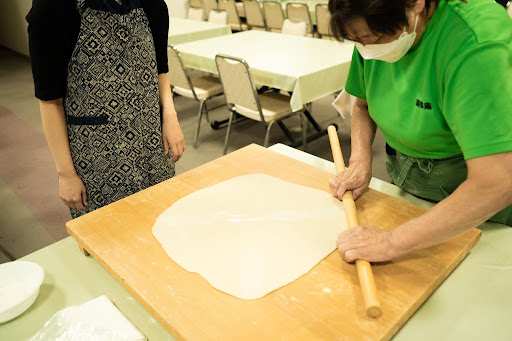
After the work surface is dusted with buckwheat flour, the dough is pressed by hand into a large, round shape. It is then gradually rolled outward with a rolling pin, becoming wider and thinner with each pass.
Step 4: Yotsudashi (Shaping the Dough into a Square)
The next step is to transform the rounded dough into a more square shape.
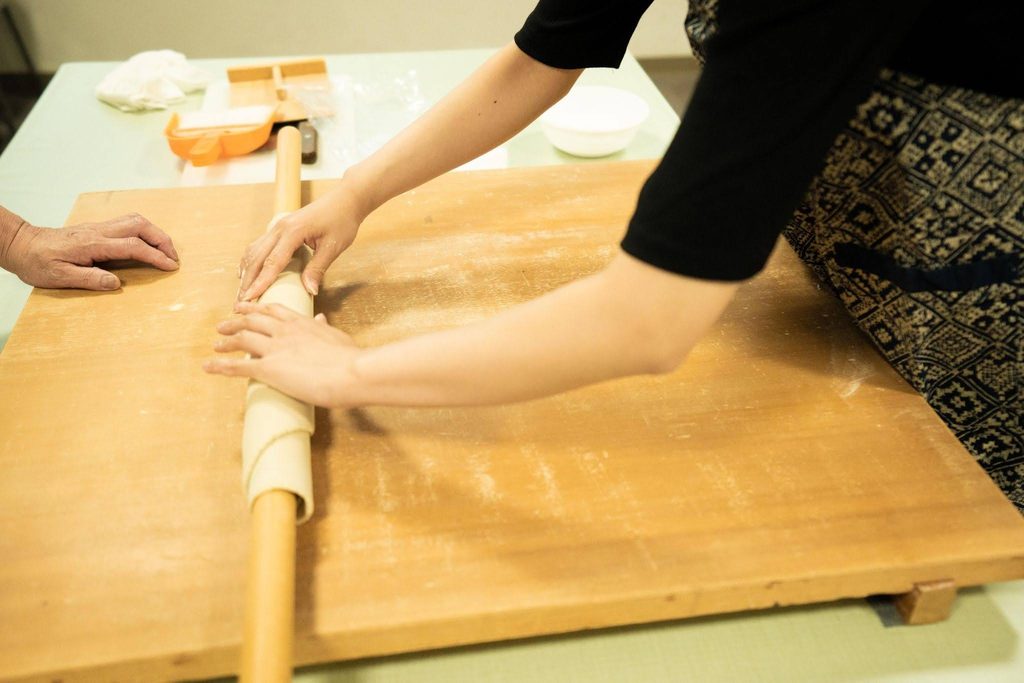
The dough is wrapped around the rolling pin and gently rolled back and forth to begin forming the corners. By applying pressure in four directions, the dough is carefully shaped into a square. Although the technique sounds simple, achieving a neat, even shape proves surprisingly tricky.
The staff explains that the most important point is not to make the dough as thin as possible, but to maintain an even thickness while achieving a square shape.
Steps 5 & 6: Nikuwake and Hon-noshi (Evening Out and Further Rolling the Dough)
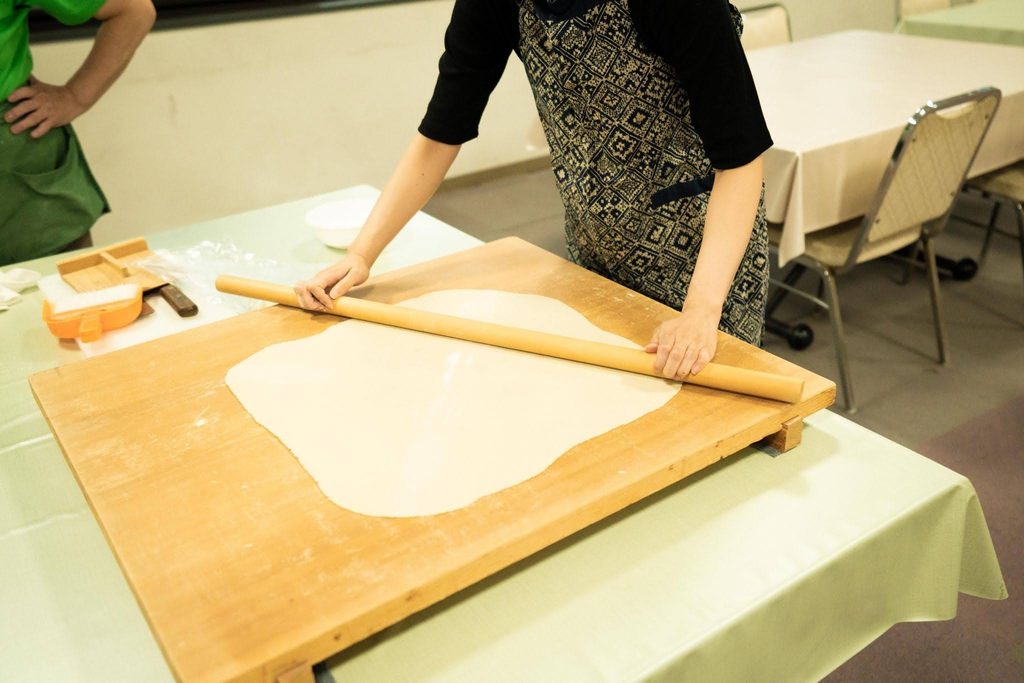
With the square shape in place, the dough is further extended using the rolling pin, stretching it into a larger, thinner sheet.
The nikuwake stage involves evening out any variations in the dough’s thickness, bringing the entire sheet to a more uniform consistency. If the dough has already been rolled to an even thickness during the previous stage, only minor adjustments are needed here. However, achieving both a square shape and an even thickness can be challenging for beginners.
The key is to pay close attention to the dough’s thickness and adjust the pressure and direction of the rolling pin accordingly. Applying too much force can cause certain areas to become thinner than others, so working carefully and gradually is essential.
In the following hon-noshi stage, the dough is rolled even thinner, refining the sheet after its thickness was evened out during the nikuwake process. With each gentle pass of the rolling pin, the dough becomes thinner and more expansive, gradually taking on a smooth, even finish. This delicate process offers a glimpse into the skill and care behind the traditional art of soba-making.
Steps 7 & 8: Tatami and Kiri (Folding and Cutting the Dough)
Before being carefully folded into neat layers, the dough is generously dusted with buckwheat flour. The folded dough is then placed on a cutting board, where the staff guides guests through the proper technique for handling the knife in preparation for the final stages of the soba-making process.
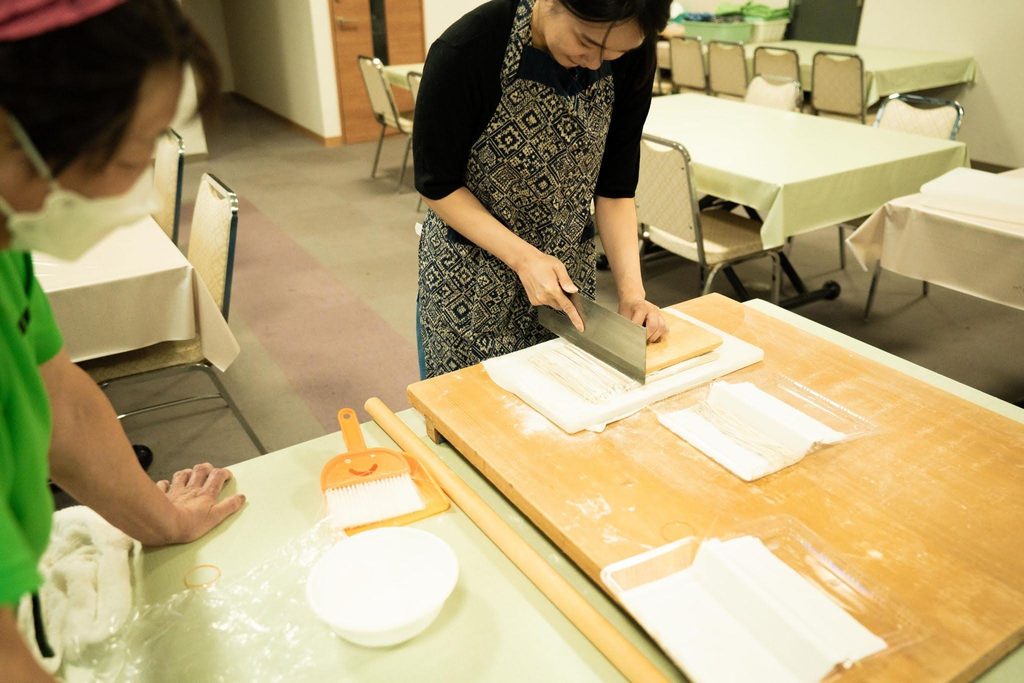
The folded dough is carefully cut into delicate strands, with a light dusting of buckwheat flour added along the way to prevent the noodles from sticking together. Achieving a consistent width requires careful attention to the angle of the blade and the pressure applied. Rather than making large movements with the knife, the key is to keep the blade steady while gently guiding the dough forward a little at a time with the supporting hand. This technique helps produce noodles of a more uniform width.
Consistency is important not only for appearance but also for the final texture. Cutting the noodles to a similar thickness allows them to cook more evenly, resulting in a more balanced and consistent texture.
Cutting the noodles proves more challenging than expected, as maintaining an even width requires considerable care and precision. Some strands turn out slightly thicker than others, but the staff’s warm encouragement makes it easy to enjoy the process without feeling pressured to get everything perfect.
Once the final strands have been cut, the hands-on soba-making experience comes to an end. The anticipation of tasting the freshly prepared noodles adds a final sense of satisfaction, with the finished dish offering a chance to appreciate both the flavor of the soba and the effort that went into making it by hand.
Discover the art of traditional soba-making in just one hour.
With the staff providing clear explanations and attentive guidance throughout, even first-time participants can feel at ease and enjoy this traditional craft.
Once the experience is complete, the freshly made soba can be cooked at the adjoining restaurant, Yuurakuan Sui, and savored on the spot, or taken home as a souvenir.
Yuurakuan also welcomes guests who wish to enjoy a meal without taking part in the soba-making experience. It is an excellent choice for those looking to savor delicious juwari soba, made entirely from buckwheat flour, during their visit to Shinshu.
Yuurakuan
Address: 5522-281 Kitayama, Chino City, Nagano Prefecture (approximately 10 minutes by car from the hotel)
Closed: Thursdays
Opening Hours:
・Shinshu Sake Museum: 9:00–15:00
・Yuurakuan Sui:
ーSummer: 11:00–15:00 (last order 14:30)
ーWinter: 11:00–14:30 (last order 14:00)
・Soba-Making Experience
ーStart time: From 10:00
ーPrice: From ¥5,500 for four servings
ーReservations are available at this rate even for groups of one to three people.
For four servings or more, please contact the facility directly for further details.
※Reservations for the soba-making experience can also be arranged through the Reception Desk at our hotel.
There are several facilities around the hotel where guests can enjoy a hands-on soba-making experience, including Yuurakuan. We will be happy to check availability at each facility and recommend suitable options.
Discover the rich natural beauty and culinary traditions of Shinshu, while enjoying a memorable stay in Tateshina.